

What is house leveling?
Bringing a settled house back to where it was built
House leveling, also called foundation leveling, lifts the parts of your home that have sunk and supports them so they stay put. In North Texas the cause is almost always the soil. Our expansive clay swells when it is wet and shrinks during dry spells, and when it pulls away from under part of the foundation, that part of the house drops.
Leveling does not mean tearing out your foundation. We place piers under the low areas, lift the house slowly while watching the readings inside, and lock it in place.
Signs you need leveling
What a settling house looks like
You do not need all of these. One or two that keep getting worse is enough reason for a free evaluation.
Sloping floors
Floors that feel uneven underfoot, or a ball that rolls on its own when you set it down.
Sticking doors
Doors that drag, will not latch, or no longer line up with the door jamb.
Wall and brick cracks
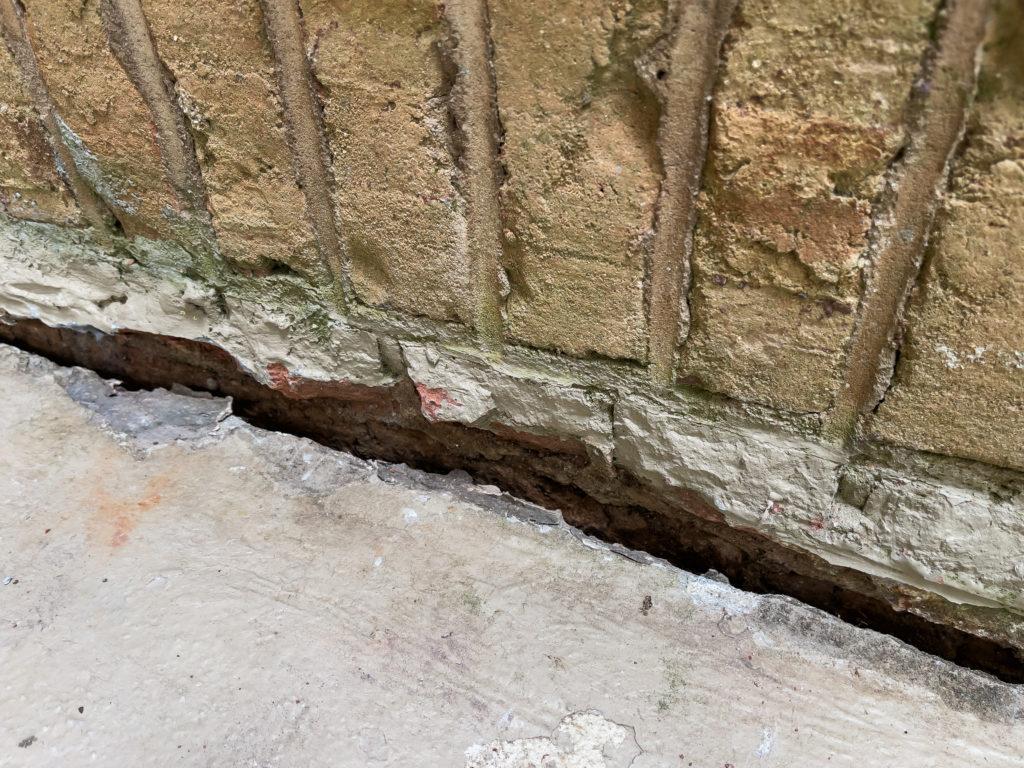
Cracks in sheetrock above doors and windows, or stair step cracks in exterior brick.
Window and trim gaps
Windows separating from the frame, or a frieze board pulling loose from the brick.
Slab cracks
Cracks in the exposed slab outside, or in tile and flooring inside.
Bouncy floors
On pier and beam homes, soft, sagging or springy spots in the floor.
How we level a slab home
Step by step, with nothing hidden
Measure every room
We take elevation readings throughout the house, about four per room, with a digital level accurate to the nearest hundredth of an inch.
Map the settlement
Those numbers go on a diagram of your home. It shows exactly where the house sank and how much, and you get the repair plan and estimate the same day.
Confirm pier locations outside
We check cracks in the slab to find the pivot point, the expansion joint, windows, and the frieze board, then match those signs to the readings. Piers are typically placed 4 to 6 feet apart.
Press the piers
At each spot we dig a hole about 2 feet square and 4 feet deep, reaching under the slab. Hardened concrete cylinders rated to 10,000 PSI are pressed into the ground one after another until the soil refuses to take more. Two story homes get dual cylinders.
Lift slowly and measure
House jacks lift the home slowly, by hand, while we watch the readings inside so the structure is never stressed. Steel shims lock in the final height.
Backfill and grade
We backfill each hole and pack the soil, then build a 6 to 8 inch slope away from the house so water drains off instead of pooling at the foundation. Exterior doors are adjusted when needed so they lock.
Pier and beam homes
Leveling a house on piers and beams
Older North Texas homes often sit on piers and beams with a crawl space underneath. They settle differently, and they are usually easier to level because we can work from below.
- Re-shim sunken piers back to level
- Add new pressed concrete or steel piers where support is missing
- Replace rotted or water damaged beams and joists
- Raise grade beams and lift the home perimeter

Cost
What does house leveling cost?
Every house is different, so we do not quote over the phone. The price depends mostly on how many piers your home needs, whether it is slab or pier and beam, how far it has settled, and how easy it is to reach the low areas.
That is why the evaluation is free for homeowners. We measure, show you the diagram, and give you a written estimate the same day. No pressure, and no charge to find out.
Why it pays to act
Settling does not fix itself
Once part of a house starts to drop, the cracks, door problems and floor slopes usually keep growing with each wet and dry season. Leveling sooner means fewer piers, less drywall and trim repair, and a home that is easier to sell. If you are selling and the buyer's lender requires foundation repair before closing, we can move quickly.
Questions
House leveling FAQ
How long does it take to level a house?
Most homes are leveled in one to two days. We will tell you the expected timeline when we give you the estimate.
Can I stay in my home while you work?
Yes. Almost all of the work happens outside or in the crawl space. We will need to come inside to take readings during the lift.
Will the cracks in my walls close up?
Many cracks tighten up as the house comes back to level, but some will still need cosmetic repair afterward. The goal of leveling is to stop the movement so repairs actually last.
Do you also fix drainage?
Yes. Poor drainage is one of the biggest reasons homes settle in the first place. We install French drains, correct drainage and put in root barriers to help protect the repair.
Find out how level your house really is
Free evaluation, exact readings for every room, and a same day estimate.